

Current Issue
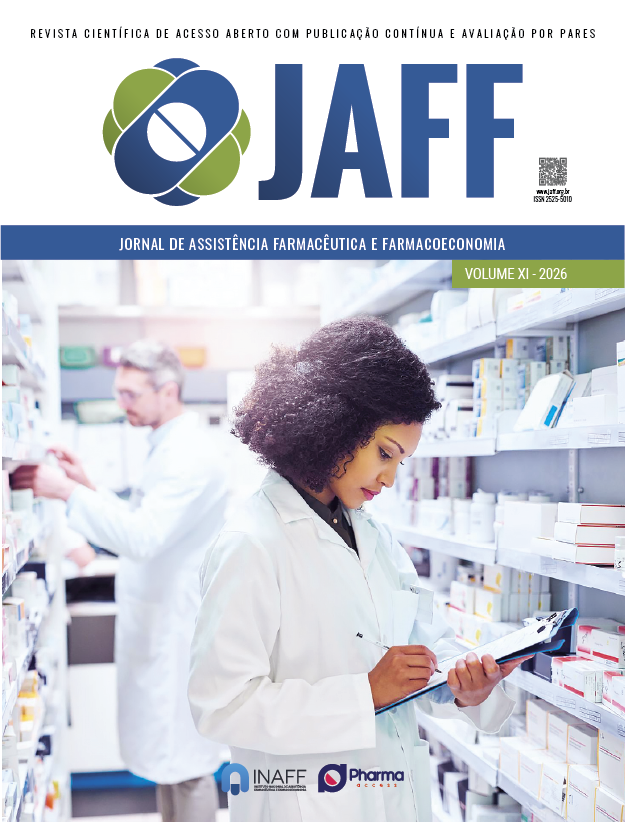
The Journal of Pharmaceutical Care and Pharmacoeconomics (JAFF) is an electronic, open-access, and continuously published journal. Its aim is to disseminate scientific output and innovative practices in the fields of pharmaceutical care, health technology assessment, and pharmacoeconomics, and to foster discussion on relevant issues related to these topics and their impact on public policy formulation and implementation, service organization, and the training of healthcare workers.
It is published by the National Institute of Pharmaceutical Services and Pharmacoeconomics (INAFF), a non-governmental, non-profit organization founded in 2017 in Salvador, Bahia, Brazil. Its primary mission is to promote technical and scientific development through research, consulting, continuing education, and the organization of events of national and international relevance. INAFF serves as the institutional editor of JAFF.
The first issue of JAFF was published on January 31, 2016. Since then, the journal has grown, evolved, and modernized, reaffirming its commitment to promoting and disseminating national scientific research. In 2022, the JAFF Award was launched during the 10th Brazilian Forum on Pharmaceutical Services and Pharmacoeconomics. This award was established to encourage high-quality scientific production in the areas of pharmaceutical services, pharmacoeconomics, and health technology assessment.
Other significant milestones include the journal’s indexing in the Directory of Open Access Journals (DOAJ) and the Regional Online Information System for Scientific Journals from Latin America, the Caribbean, Spain, and Portugal (Latindex) in 2024. Furthermore, starting in 2025, JAFF transitioned from a quarterly to a continuous publication model. JAFF is ranked as a B4 journal according to the Qualis/CAPES classification.
JAFF’s target audience includes faculty, researchers, and students in Pharmacy and other Health Sciences, as well as healthcare professionals and health service and system managers.
The Journal of Pharmaceutical Services and Pharmacoeconomics (JAFF) has strategically adopted social media as effective tools for disseminating scientific knowledge. In 2016, profiles were created on Facebook and Instagram, using a more direct approach to engage its target audience. More recently, a LinkedIn profile was created to further promote new issues and articles, thereby enhancing JAFF’s reach and visibility.
Commitment to Open ScienceJAFF adopts editorial practices aligned with the principles of Open Science, promoting transparency, collaboration, and reproducibility in knowledge production.
- Preprints: Manuscripts previously deposited in recognized preprint repositories, such as SciELO Preprints, are accepted. Submission to these repositories is not mandatory and does not prevent simultaneous submission to JAFF, provided that the DOI and the repository server are properly indicated.
- Data sharing: Authors are encouraged to make their research data available in open and publicly accessible repositories. The journal recommends using the repositories suggested by SciELO (https://data.scielo.org) and requires completion of the Open Science Compliance Form, which must be submitted as a supplementary document at the time of manuscript submission.
- Peer review: JAFF adopts a double-blind peer review system. Reviewers are selected from professionals affiliated with institutions different from those of the authors, and based on their expertise in the topic addressed. Authors may opt for one or more informed peer review modalities offered by the journal.
- Publication frequency: JAFF follows a continuous publication model, making articles available online as soon as the editorial process is completed. Publications are organized into four issues per year.
-
Licensing: JAFF applies the Creative Commons Attribution (CC BY) license to all works published in the journal. Under this license, authors agree to legally make their articles available for reuse, without prior permission or fees, for virtually any purpose. Anyone may copy, distribute, or reuse these articles, provided that the author and the original source are properly cited.
MISSION
To stimulate and disseminate national scientific output and innovative practices, and to promote the discussion of major themes and key challenges in the fields of pharmaceutical care, health technology assessment, and pharmacoeconomics and its application. Additionally, to foster the exchange of knowledge among researchers, professionals, and health system managers, and to contribute to discussions on methods and public policies within the Brazilian Unified Health System (SUS).
SCOPE
JAFF publishes works in the fields of Pharmaceutical Assistance, Health Technology Assessment, and Pharmacoeconomics, understood as follows:
- In the field of Pharmaceutical Assistance, the journal includes topics related to Pharmaceutical Policy, access to medicines, rational use of medicines, implementation of new services, monitoring and evaluation, financing, management, and clinical protocols. It also encompasses subjects related to Hospital Pharmacy, Clinical Pharmacy, Pharmaceutical Care, Pharmacovigilance, and Medication Errors.
- In the field of Health Technology Assessment, the journal covers issues related to the evaluation and management of health technologies, particularly concerning efficacy, effectiveness, real-world data, and emerging technologies.
- In the field of Pharmacoeconomics, topics include economic evaluations, such as studies on the cost of illness, cost analysis, cost-consequence analysis, cost-effectiveness, cost-utility, cost-benefit, cost-minimization, as well as budget impact and financing studies.
Publication in the journal entails no fees for authors or institutions, and access to the journal and its contents is free of charge, available electronically.
STRUCTURE
JAFF publishes works in the following sections: Original articles, review articles, case reports, commentaries, study protocols, letters to the editor, brief communications, and perspective articles.
To learn about the specific characteristics of each type of manuscript and the submission guidelines, please refer to the "Guidelines for Submission" section.
EDITORIAL BODY
Responsible, in cooperation with the Editorial Council, for the journal’s editorial policy, its institutional relations, and communication with the institutional editor, partners, collaborators, and funding organizations.
Editor-in-ChiefResponsible, in cooperation with the Editorial Council, for the journal’s editorial policy, its institutional relations, and communication with the institutional editor, partners, collaborators, and funding organizations.
Scientific EditorResponsible for managing the journal; coordinating the editorial team in matters related to standardization, translation, review, and graphic design; and serving as the liaison between the Editorial Board, authors, the Editorial Council, and reviewers.
The Scientific Editor is responsible for the preliminary evaluation of submitted materials to ensure compliance with the journal’s editorial scope and standards, and for determining their eligibility to enter the peer review and editing process.
Editorial CouncilThe Editorial Council is responsible for the journal’s editorial policy and scientific quality.
It deliberates on the acceptance or rejection of manuscripts submitted spontaneously, based on scientific merit and relevance of the contribution to the development of Pharmaceutical Assistance, Health Technology Assessment, and/or Pharmacoeconomics, deciding on their eligibility to enter the double-blind peer review process.
In cooperation with the Scientific Editor, the Council deliberates on the publication of special issues or thematic sections, the invitation of authors to contribute to such issues, and the selection of experts to serve as peer reviewers.
ReviewersThe review panel is composed of experts in Pharmacy, Health Technology Assessment, Pharmacoeconomics, Public Health, Collective Health, and other fields related to the journal’s scope, with recognized academic, scientific, or professional experience, who are committed to contributing to the journal.
Experts who are not part of this group may occasionally be invited due to their specific knowledge or experience relevant to a submitted manuscript.
Reviewers must assess whether the material meets the criteria of scientific merit and contributes to the study and/or improvement of pharmaceutical assistance, health technology assessment, or pharmacoeconomics.
If reviewers deem it necessary to recommend modifications or improvements before publication, such suggestions should be clearly stated.
JAFF adopts a double-blind peer review system. Reviewers are selected from professionals affiliated with institutions different from those of the authors, and based on their expertise in the subject area addressed. Authors may choose one or more informed peer review modalities offered by the journal.
FundingINAFF fully supports the publication costs of JAFF, in line with the institute’s mission to promote technical and scientific development through research and innovation.
Original Article
Artigo de revisão
Case report and Experience report
Study Protocol
 |
|
|
 |
|
|
 |
|
 |
|
|
 |
JAFF - JORNAL DE ASSISTÊNCIA FARMACÊUTICA E FARMACOECONOMIA is indexed in Scholar Google. |
 |
JAFF - Journal of Pharmaceutical Assistance and Pharmacoeconomics is indexed in MIGUILIM - Directory of Brazilian electronic scientific journals. |